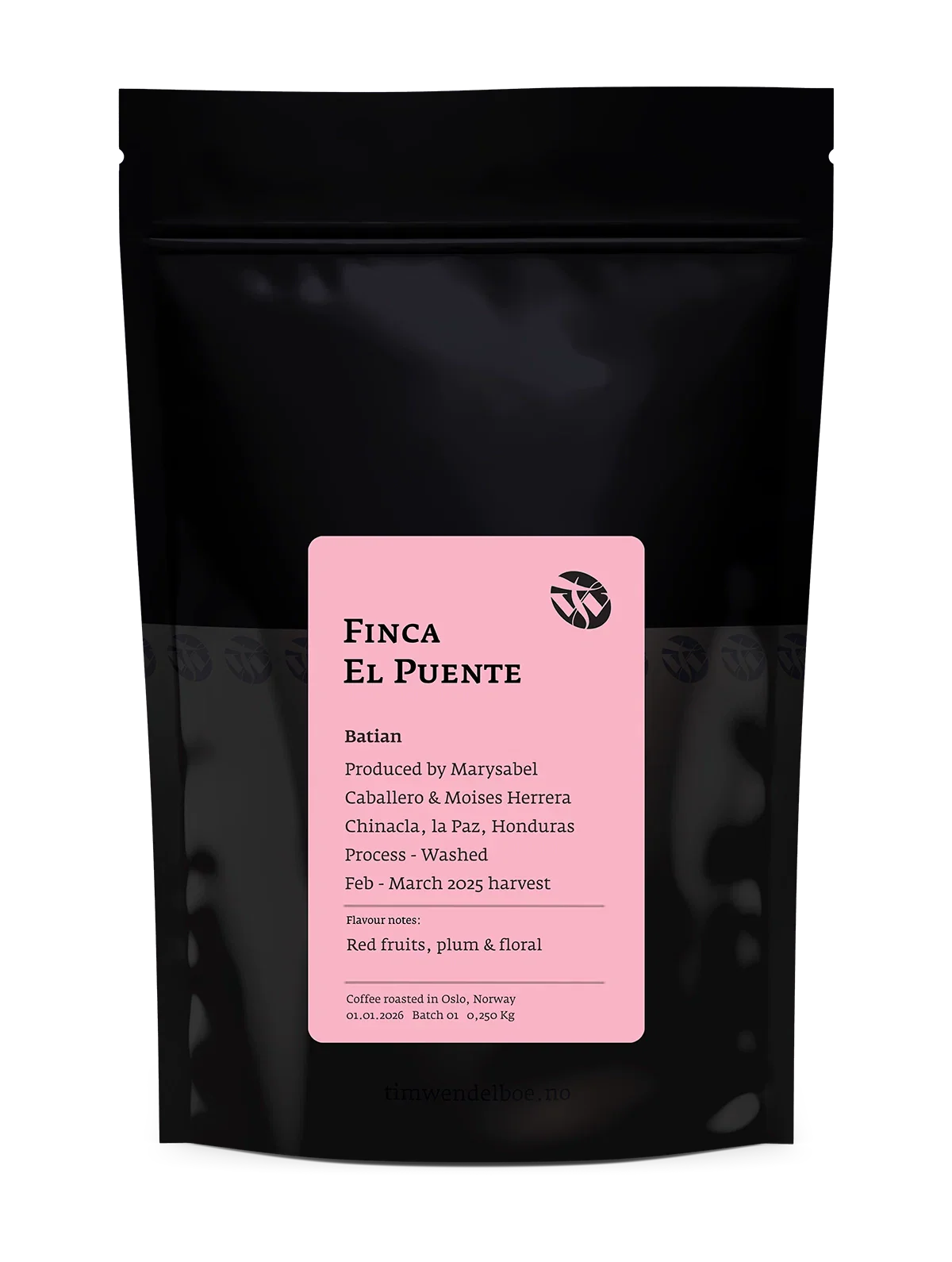
Tim Wendelboe - Finca El Puente Batian
Honduras — Marysabel Caballero & Moises Herrera, Finca El Puente Batian (Washed)
Tastes Like — 🌸 Florals • 🍒 Juicy Red Fruits • 🫐 Plum
DETAILS
- Producer: Marysabel Caballero & Moises Herrera
- Farm: Finca El Puente
- Region: Chinacla, La Paz, Honduras
- Varietal: Batian
- Process: Washed
- Altitude: 1,600–1,700 MASL
- Size: 250g
INTRO
Batian is a Kenyan hybrid cultivar — created at the Coffee Research Institute in Ruiru and released in 2010 — but this particular coffee was grown in Honduras by Tim Wendelboe's long-standing friends Marysabel Caballero and Moises Herrera at Finca El Puente. Some years ago the Caballeros planted a small number of Batian trees, and Tim has been fortunate to purchase their entire production of this rare cultivar ever since. In recent harvests the Batian has delighted with notes of violets and florals, juicy fruit notes, and a smooth milk chocolate finish — a profile that is distinctly its own, sitting apart from the SL cultivars with which Batian shares ancestral DNA.
Moises and Marysabel have been so encouraged by both the yield and the quality of their Batian that they have continued to expand its planting. For coffee lovers curious about how a fundamentally Kenyan cultivar expresses itself in the high-altitude Honduran terroir of La Paz, this is a rare and compelling opportunity.
THE PRODUCER
Marysabel Caballero is a third-generation coffee farmer who, together with her husband Moises Herrera, owns and manages over 300 hectares of land across several farms near the town of Marcala in La Paz, Honduras. Her father, Don Fabio Caballero, is widely regarded as one of the pioneers of high-quality coffee production in the country. When Fabio retired, Marysabel and Moises inherited and modernised the family wet mill, developing it into a complete dry-mill operation that gives them full control from cherry to packaged green coffee.
The Caballeros have been consistent podium finishers at the Honduras Cup of Excellence for over two decades, winning first place in 2016 with their Geisha. Tim Wendelboe has been buying coffee directly from Finca El Puente since 2009 and has worked closely with Moises to develop bespoke processing and drying protocols for the lots he selects. Exported via Boncafe and imported directly to Norway, each lot reflects years of accumulated trust and shared craft.
Whilst the farm's Catuaí plantings make up the majority of production, the Caballeros have been quietly establishing a remarkable diversity of cultivars — Geisha, Java, SL28, Batian, Pacamara, and Ethiopian varieties — all of which Tim is privileged to offer in small quantities to his guests and customers around the world.
THE PROCESS
The Washed process at Finca El Puente involves:
- 🍒 Selective Harvest — Ripe cherries are hand-picked by local pickers, who are paid a premium to sort ripe from unripe fruit at the time of picking, placing them in separate bags.
- 🔧 Depulping & Mucilage Removal — Cherries are depulped in the afternoon, and a mechanical mucilage remover partially strips the mucilage from the parchment coffee.
- 🧪 Overnight Fermentation — The parchment coffee ferments overnight, allowing flavour development before washing.
- 💧 Washing & Grading — The coffee is washed with clean water in a washing channel, which simultaneously floats out undeveloped or low-density beans, ensuring only the densest, most developed parchment moves forward.
- 💧 Centrifuge Drying — Excess water is removed via centrifuge before the coffee proceeds to drying.
- ☀️ Shade Drying on Raised Beds — All lots purchased by Tim are dried slowly on raised beds covered with shade nets, set up near the Caballero home in Marcala where the drier climate encourages even, gradual drying. Beds are raked throughout the day and covered at night to prevent condensation.
This careful, methodical approach produces a clean and expressive cup that honours the distinct character of each cultivar — in this case, the intriguing floral and fruit-forward personality of the Batian.
THE CUP
This Batian from Finca El Puente offers a sweet and smooth drinking experience that consistently surprises with its elegance and layers. Expect the cup to open with violet and floral aromatics, move through juicy, tart red fruit and berry notes, and resolve into a gentle milk chocolate sweetness on the finish. It is a coffee that rewards patient tasting, revealing new dimensions as it cools.
Flavour Notes
- 🌸 Floral
- 🍒 Juicy Red Fruits
- 🫐 Plum
Honduras — Marysabel Caballero & Moises Herrera, Finca El Puente Batian (Washed)
Tastes Like — 🌸 Florals • 🍒 Juicy Red Fruits • 🫐 Plum
DETAILS
- Producer: Marysabel Caballero & Moises Herrera
- Farm: Finca El Puente
- Region: Chinacla, La Paz, Honduras
- Varietal: Batian
- Process: Washed
- Altitude: 1,600–1,700 MASL
- Size: 250g
INTRO
Batian is a Kenyan hybrid cultivar — created at the Coffee Research Institute in Ruiru and released in 2010 — but this particular coffee was grown in Honduras by Tim Wendelboe's long-standing friends Marysabel Caballero and Moises Herrera at Finca El Puente. Some years ago the Caballeros planted a small number of Batian trees, and Tim has been fortunate to purchase their entire production of this rare cultivar ever since. In recent harvests the Batian has delighted with notes of violets and florals, juicy fruit notes, and a smooth milk chocolate finish — a profile that is distinctly its own, sitting apart from the SL cultivars with which Batian shares ancestral DNA.
Moises and Marysabel have been so encouraged by both the yield and the quality of their Batian that they have continued to expand its planting. For coffee lovers curious about how a fundamentally Kenyan cultivar expresses itself in the high-altitude Honduran terroir of La Paz, this is a rare and compelling opportunity.
THE PRODUCER
Marysabel Caballero is a third-generation coffee farmer who, together with her husband Moises Herrera, owns and manages over 300 hectares of land across several farms near the town of Marcala in La Paz, Honduras. Her father, Don Fabio Caballero, is widely regarded as one of the pioneers of high-quality coffee production in the country. When Fabio retired, Marysabel and Moises inherited and modernised the family wet mill, developing it into a complete dry-mill operation that gives them full control from cherry to packaged green coffee.
The Caballeros have been consistent podium finishers at the Honduras Cup of Excellence for over two decades, winning first place in 2016 with their Geisha. Tim Wendelboe has been buying coffee directly from Finca El Puente since 2009 and has worked closely with Moises to develop bespoke processing and drying protocols for the lots he selects. Exported via Boncafe and imported directly to Norway, each lot reflects years of accumulated trust and shared craft.
Whilst the farm's Catuaí plantings make up the majority of production, the Caballeros have been quietly establishing a remarkable diversity of cultivars — Geisha, Java, SL28, Batian, Pacamara, and Ethiopian varieties — all of which Tim is privileged to offer in small quantities to his guests and customers around the world.
THE PROCESS
The Washed process at Finca El Puente involves:
- 🍒 Selective Harvest — Ripe cherries are hand-picked by local pickers, who are paid a premium to sort ripe from unripe fruit at the time of picking, placing them in separate bags.
- 🔧 Depulping & Mucilage Removal — Cherries are depulped in the afternoon, and a mechanical mucilage remover partially strips the mucilage from the parchment coffee.
- 🧪 Overnight Fermentation — The parchment coffee ferments overnight, allowing flavour development before washing.
- 💧 Washing & Grading — The coffee is washed with clean water in a washing channel, which simultaneously floats out undeveloped or low-density beans, ensuring only the densest, most developed parchment moves forward.
- 💧 Centrifuge Drying — Excess water is removed via centrifuge before the coffee proceeds to drying.
- ☀️ Shade Drying on Raised Beds — All lots purchased by Tim are dried slowly on raised beds covered with shade nets, set up near the Caballero home in Marcala where the drier climate encourages even, gradual drying. Beds are raked throughout the day and covered at night to prevent condensation.
This careful, methodical approach produces a clean and expressive cup that honours the distinct character of each cultivar — in this case, the intriguing floral and fruit-forward personality of the Batian.
THE CUP
This Batian from Finca El Puente offers a sweet and smooth drinking experience that consistently surprises with its elegance and layers. Expect the cup to open with violet and floral aromatics, move through juicy, tart red fruit and berry notes, and resolve into a gentle milk chocolate sweetness on the finish. It is a coffee that rewards patient tasting, revealing new dimensions as it cools.
Flavour Notes
- 🌸 Floral
- 🍒 Juicy Red Fruits
- 🫐 Plum
Original: $34.00
-65%$34.00
$11.90Description
Honduras — Marysabel Caballero & Moises Herrera, Finca El Puente Batian (Washed)
Tastes Like — 🌸 Florals • 🍒 Juicy Red Fruits • 🫐 Plum
DETAILS
- Producer: Marysabel Caballero & Moises Herrera
- Farm: Finca El Puente
- Region: Chinacla, La Paz, Honduras
- Varietal: Batian
- Process: Washed
- Altitude: 1,600–1,700 MASL
- Size: 250g
INTRO
Batian is a Kenyan hybrid cultivar — created at the Coffee Research Institute in Ruiru and released in 2010 — but this particular coffee was grown in Honduras by Tim Wendelboe's long-standing friends Marysabel Caballero and Moises Herrera at Finca El Puente. Some years ago the Caballeros planted a small number of Batian trees, and Tim has been fortunate to purchase their entire production of this rare cultivar ever since. In recent harvests the Batian has delighted with notes of violets and florals, juicy fruit notes, and a smooth milk chocolate finish — a profile that is distinctly its own, sitting apart from the SL cultivars with which Batian shares ancestral DNA.
Moises and Marysabel have been so encouraged by both the yield and the quality of their Batian that they have continued to expand its planting. For coffee lovers curious about how a fundamentally Kenyan cultivar expresses itself in the high-altitude Honduran terroir of La Paz, this is a rare and compelling opportunity.
THE PRODUCER
Marysabel Caballero is a third-generation coffee farmer who, together with her husband Moises Herrera, owns and manages over 300 hectares of land across several farms near the town of Marcala in La Paz, Honduras. Her father, Don Fabio Caballero, is widely regarded as one of the pioneers of high-quality coffee production in the country. When Fabio retired, Marysabel and Moises inherited and modernised the family wet mill, developing it into a complete dry-mill operation that gives them full control from cherry to packaged green coffee.
The Caballeros have been consistent podium finishers at the Honduras Cup of Excellence for over two decades, winning first place in 2016 with their Geisha. Tim Wendelboe has been buying coffee directly from Finca El Puente since 2009 and has worked closely with Moises to develop bespoke processing and drying protocols for the lots he selects. Exported via Boncafe and imported directly to Norway, each lot reflects years of accumulated trust and shared craft.
Whilst the farm's Catuaí plantings make up the majority of production, the Caballeros have been quietly establishing a remarkable diversity of cultivars — Geisha, Java, SL28, Batian, Pacamara, and Ethiopian varieties — all of which Tim is privileged to offer in small quantities to his guests and customers around the world.
THE PROCESS
The Washed process at Finca El Puente involves:
- 🍒 Selective Harvest — Ripe cherries are hand-picked by local pickers, who are paid a premium to sort ripe from unripe fruit at the time of picking, placing them in separate bags.
- 🔧 Depulping & Mucilage Removal — Cherries are depulped in the afternoon, and a mechanical mucilage remover partially strips the mucilage from the parchment coffee.
- 🧪 Overnight Fermentation — The parchment coffee ferments overnight, allowing flavour development before washing.
- 💧 Washing & Grading — The coffee is washed with clean water in a washing channel, which simultaneously floats out undeveloped or low-density beans, ensuring only the densest, most developed parchment moves forward.
- 💧 Centrifuge Drying — Excess water is removed via centrifuge before the coffee proceeds to drying.
- ☀️ Shade Drying on Raised Beds — All lots purchased by Tim are dried slowly on raised beds covered with shade nets, set up near the Caballero home in Marcala where the drier climate encourages even, gradual drying. Beds are raked throughout the day and covered at night to prevent condensation.
This careful, methodical approach produces a clean and expressive cup that honours the distinct character of each cultivar — in this case, the intriguing floral and fruit-forward personality of the Batian.
THE CUP
This Batian from Finca El Puente offers a sweet and smooth drinking experience that consistently surprises with its elegance and layers. Expect the cup to open with violet and floral aromatics, move through juicy, tart red fruit and berry notes, and resolve into a gentle milk chocolate sweetness on the finish. It is a coffee that rewards patient tasting, revealing new dimensions as it cools.
Flavour Notes
- 🌸 Floral
- 🍒 Juicy Red Fruits
- 🫐 Plum